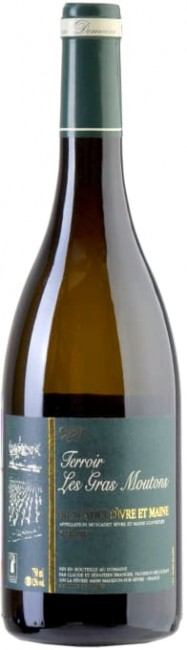
| Producer | Claude Branger |
| Country | France |
| Region | Muscadet |
| Subregion | Muscadet-Sevre et Maine |
| Varietal | Melon de Bourgogne |
| Vintage | 2024 |
| Sku | 123744 |
| Size | 750ml |

WB
Wine maker notes
From 18 acres of vines growing in a celebrated vineyardnamed the Fat Sheep. * This is in the adjacent commune of Saint Fiacre, which is the smallest of the 23 communes in the Sevre et Maine AC and one with some of the best grape growing land. The rocky gneiss soil here is thin, between 6-14 inches deep, in a seam of amphibolite, a greenish metamorphic rock. The vines were planted between 1930 and 1986, and average more than 50 years old. The meager soil and the old vines give naturally low yields, averaging 45 hl/ha. The wine rests on its lees in underground tanks for twelve to fourteen months. Ripe, round, concentrated and intensely mineral, this wine can age beautifully, developing aromas with bottle age that are a cross between Riesling and Pinot Blanc. A productive year sees 3,625 cases made. * Fat Sheep is the current literal translation, but it?s pretty far off base. Gras moutons comes from the old local dialect for gros moton or gros motton. Gros refers to something important, as in big or prominent. Moton is derived from mons in Latin, referring to mont (mount in English), the base for montagne or mountain. Motton comes from motte, referring to a natural levy or rise in the ground. Whether you go with moton or motton, it?s clear that Gras Moutons refers to a high point of ground in the area.
Producer
laude Branger is a tall, soft-spoken gentleman with silver hair. He dresses neatly and modestly, and there is about him, as there is about his wines, a clear sense of refinement. His grandfather developed the wine domain of Haute Fevrie during the First World War. Today his wife Therese continues to manage the home office in Maison-sur-Sevre (as well as an eye-popping vegetable garden), while his son Sebastien is taking the lead on the affairs of the domain. They farm 65 acres in two parishes in the heart of the Muscadet Sevre et Maine appellation. Among the small cadre of committed growers-and it remains a small cadre-the father and son team of Claude and Sebastien rank among the top. Claude was an early member of Terra Vitis, an organization that sets guidelines for sustainable farming and monitors its members? practices to ensure compliance. Subsequently, Sebastien embarked the domain on the road to full-fledged organic farming. The first parcels received certification in 2016 and by vintage 2019 all of the domain?s parcels will be fully certified. Sebastien has introduced three new wines: a methode traditionnelle sparkling wine made entirely from Melon, and two new crus. The crus communaux are the most exciting thing to come down the Muscadet pike in recent time, and are meant to be the apex of the pyramid in Muscadet (the base being made up of generic Muscadet, and the middle being made up of the three sub-appellations of Sevre et Maine, Coteaux de la Loire, and Cotes de Grandlieu). The INAO recognized the following crus in 2011: Gorges, based on clay and quartz; 29. 6 acres delimited. Le Pallet, based on gabbro, gneiss, and orthogneiss (all metamorphic); 163 acres delimited and this has the largest surface because the vineyard area belongs to the local cooperative. Clisson, based on granite with quartz and mica; 49 acres delimited. Four are to follow and official recognition could come in 2018: Monnieres-St Fiacre, based on gneiss; 32 acres delimited. Chateau-Thebaud, based on sandy granite; 27 acres delimited. Goulaine, gneiss and schist; 15 acres delimited. Mouzillon-Tillieres, based on gabbro; 22 acres delimited. Further down the road, three more are up for recognition: La Haye-Fouaissiere, based on gneiss, orthogneiss, and amphibolites; 30 acres delimited. Vallet, based on schist and gabbro; 22 acres delimited. Champtoceaux, in Coteaux de la Loire and the only one of these ten not in Sevre-et-Maine; 15 acres delimited. Total surface for these crus communaux is 376 acres. An homogeneous soil base combined with the inherent quality of a given site are the main criteria, coupled with lower maximum yields-45 hectoliters per hectare for a cru compared to 55 hl/ha for the sub-appellations-and a minimum ageing period on the lees (17 months for Le Pallet and 24 months for Gorges and Clisson, but in practice the aging period exceeds 24 months for most of these wines). The Brangers have vines in Monnieres-St Fiacre and in Chateau-Thebaud. The vines and the wines from both crus are treated identically, and what you get in the bottle is a clear reflection of the differing terroir. The father and son team prunes its vines for low yields, harvests by hand (a rarity in this land of machine harvesting), and lets its wine rest on the lees until bottling, which is done without fining and with a light filtration-the classic sur lie technique. It?s this technique that gives good Muscadet wine its freshness and lift. Contrary to popular opinion, Melon is not, if allowed to ripen properly, naturally high in acid; it?s the lees contact and the resulting CO2 gas that give the wine its crisp spice and zest (acid Muscadet is usually the product of under ripe, high-yielding machine-harvested grapes). Dutch traders introduced the Melon grape to the region from Burgundy in the 1600s. They wanted grapes for distilling, and the city of Nantes was within ready reach of their boats. An extreme winter in 1709 wiped out the red varieties then locally grown and thereafter Melon came to rule the roost. Today, there are four appellations in the region: the base appellation of Muscadet followed by the three sub-appellations. The Muscadet Sevre et Maine appellation is the most varied and by far the largest (this AC produces more wine than any other in the Loire Valley). A generation ago, most of its wine was forgettable except that from a few dedicated growers such as Claude Branger. Nowadays, a revolution in quality is taking place. There are wines of revelation made here, wines that are soft yet shockingly vigorous, imbued with scents of bread, lemon freshness, and sea salt minerality-a palette of aromas that in the better renditions follows through with flavor intensity and length. This is wine of the north Atlantic coast, the product of Brittany?s great shelf of granite. Melon de Bourgogne is a white cousin to Gamay, and like Gamay it can be easy, it can be delicious, and it can surprise. For those of you who like white wine that favors detailed verticality, good Muscadets are some of the best white wine values in the world.

| Quantity: |

| Quantity: |

| Quantity: |
_________________________________________________________________________________________________
Prefer texting? You can reach our service department at
757-581-3848
In person customer service is available during our normal business hours through email and phone.
Please note shipping times may be increased slightly;
We will continue to work diligently to get your orders out to you as fast as possible!
 | |
| Mon - Fri | 9:00 am - 5:00 pm |
| Sat - Sun | Closed |


| Copyright © 2025 All rights reserved • Website Powered by WineFetch |


Sign up for the Yiannis Wine Shop newsletter and receive a promo code for FREE SHIPPING on your purchase of $195 or more*!
(This promotion will automatically apply)
Not valid with any other promos.
Also be among the first to know about upcoming specials at the store!